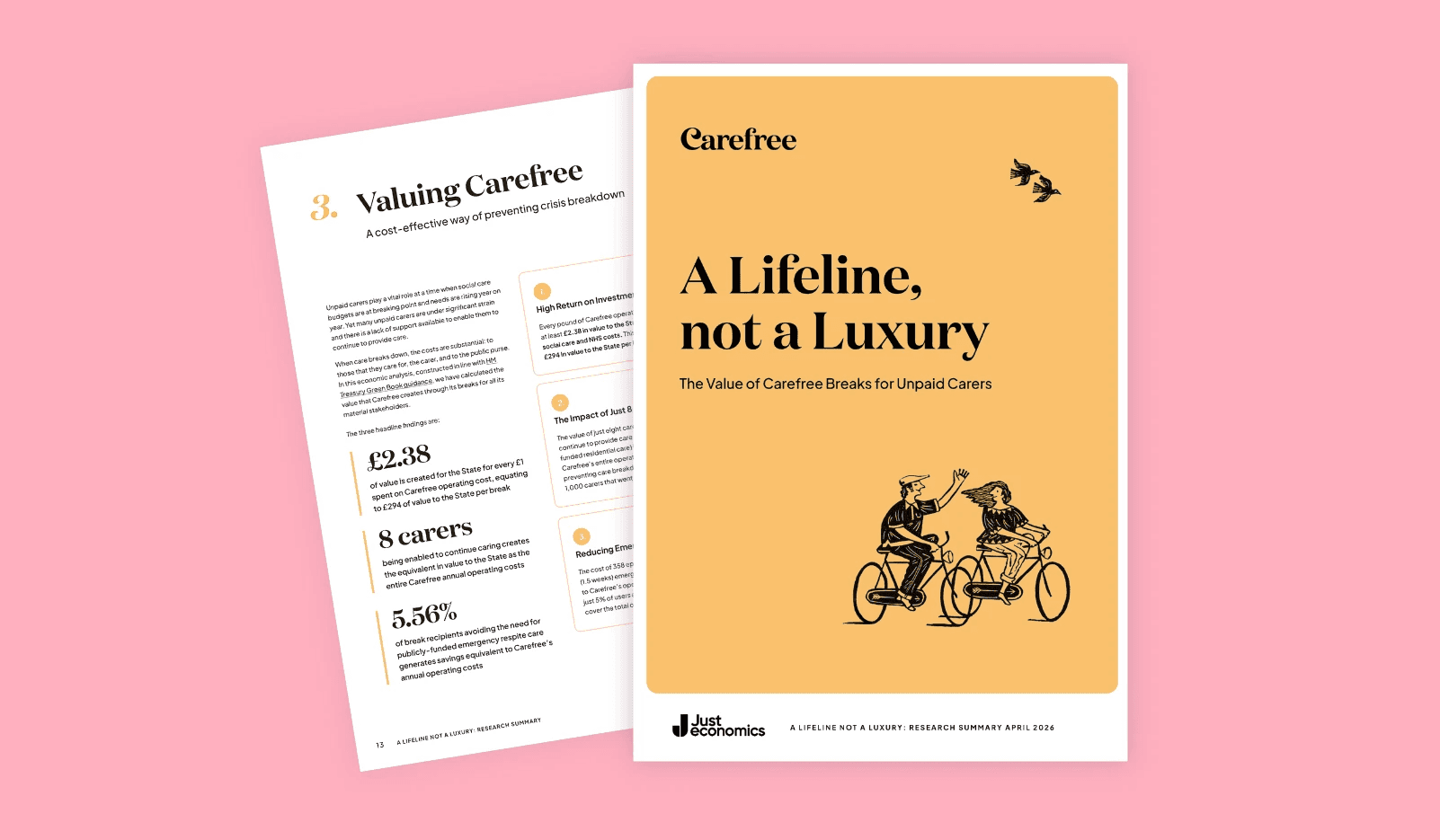
Carefree has partnered with leading research firm Just Economics to publish a landmark impact report and the findings make for essential reading for anyone who cares about the UK’s 5.8 million unpaid carers.
For years, we've known that a break changes everything for an unpaid carer. We've seen it in the messages carers send us after their stays, in the way they describe finally being able to breathe. But knowing something and proving it are two very different things. Today, we have the proof.
Why we commissioned this research
The UK's 5.8 million unpaid carers save the state £184 billion every year — more than the entire NHS budget. They are the invisible backbone of our health and social care system, quietly sacrificing their own health and wellbeing to look after the people they love. Yet 65% say they cannot access a break when they need one.
At Carefree, we've always believed that a break isn't a luxury — it's a lifeline. But in a world where funding decisions are made on evidence, belief isn't enough. We needed the data to make the case: not just for carers, but for the policymakers, commissioners, and decision-makers who hold the power to change things. So we commissioned Just Economics to find it.
The numbers
The findings are extraordinary.
77% of carers said their Carefree break contributed "a lot" to preventing a crisis breakdown
£294 saved from the public purse per break, through avoided NHS costs and residential care admissions
£2,617 in total social benefit generated by every single break delivered
£16.87m in social value created by Carefree in 2025 alone
By 2029, Carefree is projected to save the public purse £26 million in avoided emergency care and NHS costs. Avoiding just eight residential state care placements (through the carer continuing to care) covers our entire annual operating budget. The solution exists. It just needs to scale.
The Voices Behind the Data
The report is anchored in economic data, but it is enriched by the real experiences of carers, hotel partners, and community organisations.
The QHotels Collection has donated 5,000 breaks to Carefree a remarkable contribution. Gail Peters, Head of Revenue Management, explains their motivation simply: "Proud to partner with Carefree to offer unpaid carers respite, thanks to a simple and flexible process." Hotels that donate spare rooms through Carefree's easy-to-use platform aren't just doing something generous. The research suggests it is likely to be financially neutral or even beneficial, with in-hotel spending by carers offsetting the cost of the donated room.
Carers Oxfordshire has referred over 1,000 carers to Carefree, helping deliver £182,600 in value to their community. Michelle Evans sums up the programme with characteristic directness: "Great service, helpful, clear guidance and an amazing offer for unpaid carers — genius."
These are not isolated examples. They reflect a model that works precisely because it brings together the generosity of the hospitality sector, the reach of community partners, and the efficiency of a tech-first platform to deliver something carers desperately need.
The Report's Four Calls to Action
1. National Government — Incentivise hotels to donate rooms The Treasury should explore mechanisms to encourage more hotels to donate spare inventory. With £284 saved per break in NHS and social care costs, the return on any such incentive would be swift and significant.
2. Local Authorities and NHS Trusts — Fund the £38 administration fee Currently, carers pay a £38 admin fee to access a Carefree break. The report recommends that Local Authorities and NHS Trusts cover this cost. The return on that investment? £7.91 for every £1 spent — through avoided emergency respite and delayed residential care entry. This is one of the clearest cases for public investment you will find anywhere in the social care landscape.
3. Hotels — Donate spare rooms The ask is modest: one room, per hotel, per week. The process is simple. The platform is built. The impact — as this report demonstrates — is profound. For hotels, it is the right thing to do, and the evidence suggests it is not a financial sacrifice.
4. Carefree: Deliver two breaks per year from 2026 The research shows that the wellbeing benefits of a single break are real but temporary. The daily demands of caring mean that sustained impact requires regular access to respite. From 2026, Carefree is committing to delivering two breaks per year to carers, ensuring that the restoration of capacity is not a one-off event but an ongoing support.
As Sir Ed Davey Says…
“Unpaid carers are truly remarkable. Day in, day out, they selflessly dedicate their lives to care for their loved ones.
“From arranging appointments to managing complex medication, caring can be challenging. Yet, unpaid carers do it all out of love for their friend or family member.
“They are the unsung heroes of our social care system. Without them our NHS and our communities simply would not function.
“So I welcome this report from Carefree. Ensuring carers have access to respite should be the norm, not a luxury. We will not rest until this is funded and written into law. Only when unpaid carers are given the time and support to look after themselves, can they continue caring for their loved ones.”
I welcome this report from Carefree. Ensuring carers have access to respite should be the norm, not a luxury. We will not rest until this is funded and written into law. Only when unpaid carers are given the time and support to look after themselves, can they continue caring for their loved ones.
Sir Ed Davey, MP & Leader of the liberal democrats
Download the Report
A Lifeline not a Luxury is free, thorough, and written to be read by everyone: carers, commissioners, policymakers, hotel operators, and anyone who wants to understand the true value of supporting the people who hold our communities together.
Want to understand exactly how the data was gathered and the social value calculated? The full economic analysis and methodology is also available to download.
Who are Just Economics?
Just Economics is one of the UK's leading social value research organisations, specialising in putting rigorous economic evidence behind social causes. They work with charities, businesses, and public bodies to measure the true cost — and value — of social interventions. Their methodology is robust, their findings are independent, and their conclusion is clear: supporting carer breaks is not a welfare add-on. It is rational policy.